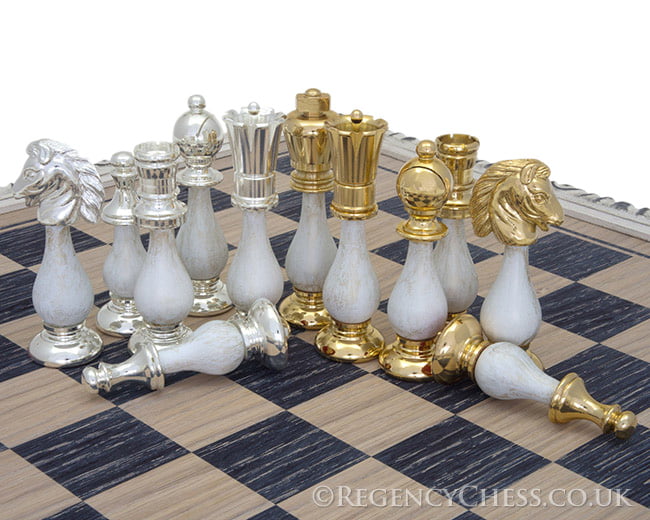

If you were to purchase two of the same chess set a year apart and compare them side by side, you’ll notice that whilst the pieces remain mostly consistent within one set, there may be slight differences across them. These subtle differences are often what give handmade chess pieces their charm and character.
In a world that increasingly uses mass production and machine precision, hand-carved chess pieces stand out because they still carry visible traces of the people who made them.
The Human Element of Craftsmanship
Unlike injection-moulded plastic pieces or fully machine-produced sets, hand-carved chessmen are shaped and finished by skilled artisans. Even when they follow the same pattern or template, every movement of the carving tool is guided by hand.
Tiny differences naturally emerge during the process:
- One knight may have a slightly sharper jawline
- Another may feature deeper carving around the mane
- The curvature of a bishop’s mitre may vary slightly between pieces
These variations are often difficult to notice unless pieces are closely compared side by side, but they are part of what makes handcrafted chess sets feel authentic.
Knights Reveal the Most Individuality
The knight is usually the easiest piece to spot subtle differences, as unlike pawns or rooks, which are largely symmetrical and turned on a lathe, knights require extensive hand carving.
Each knight is individually shaped from a solid block of wood, with artisans carefully carving:
- The face
- Mane
- Ears
- Mouth
- Jawline
Because of this, knights often become the signature of a luxury chess set. Experienced collectors can sometimes identify particular carving styles simply by studying the knight’s shape and expression.
Some knights appear fierce and aggressive, while others look elegant or refined. Even within the same pair, small differences often remain.
Natural Wood Grain Plays a Role
Wood itself is another reason why handcrafted chess pieces are never truly identical. Every piece of wood has its own unique grain pattern, density, and colouration.
Even when pieces are carved from the same species – such as ebony, rosewood, or boxwood – no two sections of timber are exactly alike. One bishop may display a slightly darker tone, while another may reveal more visible grain patterns beneath the finish.
Over time, these natural differences can become even more noticeable as the wood develops a patina through age and handling.
Drying and Ageing Affect the Final Result
Before chess pieces are carved, the wood is dried for weeks or months to remove moisture and stabilise the material. Even with careful preparation, wood remains a natural substance that reacts slightly differently from piece to piece.
Temperature, humidity, and grain direction can all subtly influence how a piece behaves during carving and finishing. These factors may lead to minute differences in:
- Shape
- Weight
- Texture
- Finish absorption
Again, these are not defects – they are part of working with genuine natural materials.
Hand Finishing Creates Further Variation
After carving, many premium chess pieces are sanded, polished, lacquered, or waxed by hand. This finishing stage introduces another level of individuality.
A craftsman may slightly soften one edge more than another, apply stain differently across a grain pattern, or polish one knight to a slightly richer sheen than its counterpart. The overall set remains visually cohesive, but small details make each piece unique.
Why Perfect Uniformity Isn’t Always Desirable
Ironically, complete uniformity can sometimes make a chess set feel less special. Machine-made pieces may be perfectly identical, but they can also lack personality.
Handcrafted sets appeal to many collectors precisely because they retain subtle signs of human workmanship. Those tiny imperfections and variations remind us that real people shaped each piece individually, rather than a machine stamping out thousands of identical copies.
For many enthusiasts, this individuality gives handcrafted sets far greater character.
Traditional Craftsmanship Still Matters
Many of the world’s finest chess sets are still produced using traditional carving techniques that have been passed down through generations. In some workshops, artisans spend years learning how to carve knights consistently and accurately.
Even with modern tools assisting certain stages of production, hand-finishing remains essential for achieving the detail and personality associated with luxury chess pieces.
This blend of tradition, skill, and natural materials is a major reason why handcrafted chess sets continue to hold such a strong appeal.